

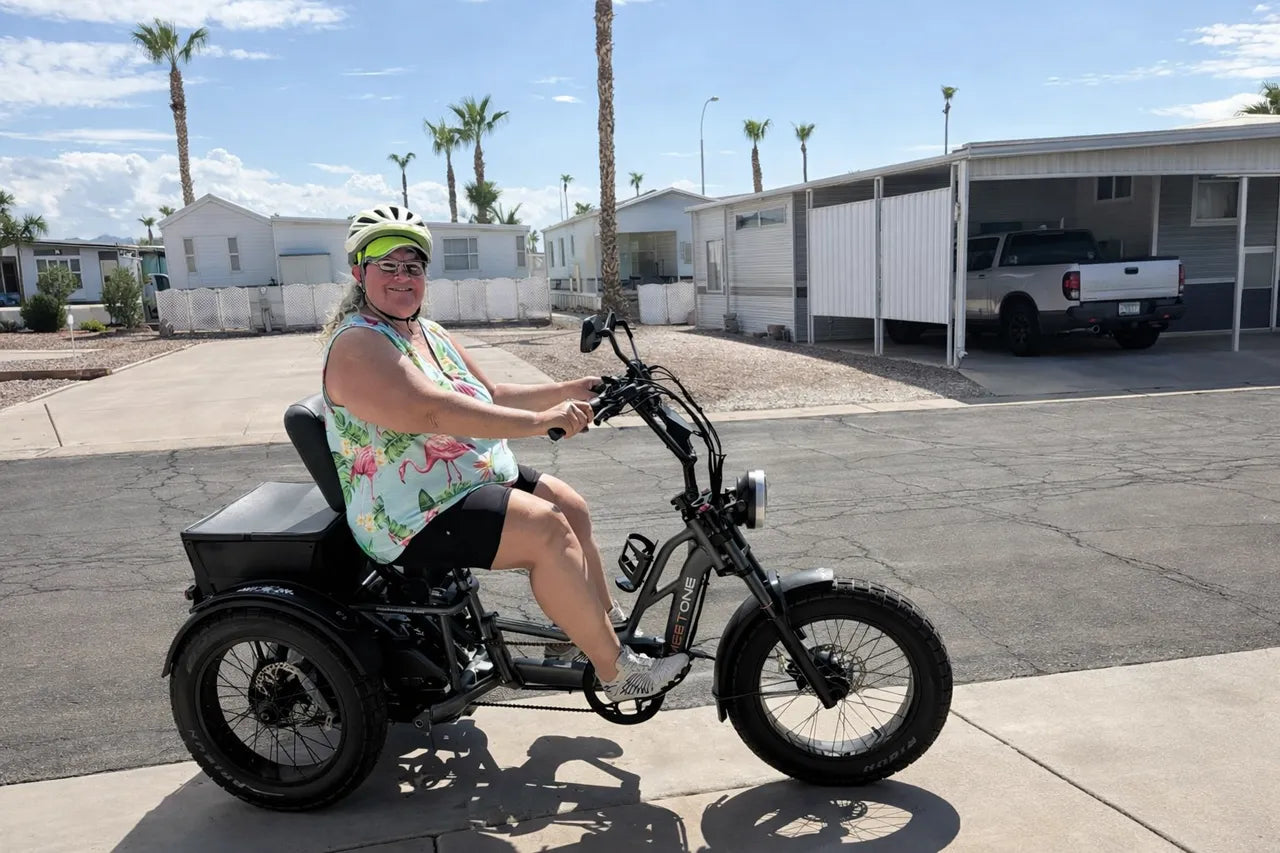
Braking on an electric trike is simple and familiar.
If you’ve ever ridden a modern bicycle or driven a car, you already understand the basic idea. Electric trikes use hand-operated brake levers, and the amount of pressure you apply determines how quickly you stop.
For riders who are new to electric trikes—or returning to cycling after many years—the key is not complexity, but confidence.
Understanding the Brake Levers
Most electric trikes are equipped with brake levers mounted on the handlebars. When you need to slow down or stop, you pull the levers toward the grips. That’s it.
If you haven’t ridden a bike in a long time, the motion may feel unfamiliar at first. This is completely normal. Like learning the feel of a new car’s brake pedal, it takes a little time to understand how much pressure to apply and when.
The important thing to remember is that braking is progressive, not abrupt. The harder you pull the lever, the faster you stop. Smooth, controlled pressure leads to smooth, controlled stopping.
Front Brake vs. Rear Brake
Electric trikes typically have both front and rear brakes, and how you use them depends on riding conditions.
- On flat ground, many riders use the rear brake alone or lightly engage both brakes.
- When going downhill, it’s best to use both brakes together for balanced, controlled stopping.
- As you gain experience, you’ll naturally develop a feel for when to rely more on one brake or the other.
There’s no single “correct” way—what matters is staying smooth and predictable.
Common Disc Brake Configurations on Electric Trikes
Electric trikes generally use one of two disc brake setups. Both are widely used, and both are safe when properly designed and adjusted.
Three-Wheel Disc Brake Setup
In this configuration, all three wheels have their own disc brakes:
- one disc on the front wheel
- one disc on each rear wheel
This setup provides the strongest and most evenly distributed braking force. It is commonly found on higher-powered trikes, heavier-duty models, or trikes designed for steep terrain and heavier loads.
Front Disc + Rear Axle Disc Setup
In this configuration:
- the front wheel has one disc brake
- the rear axle has a single disc brake that slows both rear wheels together
This is the most common setup on recreational and consumer electric trikes. It offers more than enough stopping power for everyday riding while keeping the system simpler and easier to maintain.
The key point is that more brake discs does not automatically mean safer braking. Overall braking performance depends on vehicle weight, speed, motor power, terrain, and how well the system is tuned—not just the number of discs.
A Helpful Hand Position for New Riders
For first-time riders, hand position can make a big difference in confidence.
A common recommendation is to:
- keep your thumbs and palms resting on the grips
- rest one or two fingers lightly on the brake levers
This keeps your brakes within immediate reach. In busy areas, crowded paths, or tight spaces, having your fingers already on the levers allows you to react quickly without panic or fumbling.
Once you’re riding in open, quiet areas and feel more relaxed, you can hold the grips normally.
Brake Feel Takes Time—And That’s Normal
Different braking systems feel different, even within the same category of bikes. Just like cars, some brakes feel softer, some firmer, and some respond very quickly.
If you don’t feel perfectly comfortable during a short test ride, don’t be discouraged. As you spend more time riding, your hands naturally learn:
- how much pressure to apply
- how early to start braking
- how the trike responds at different speeds
Confidence comes from repetition, not from getting it perfect on day one.
Types of Brakes You’ll Find on Electric Trikes
Most modern electric trikes use disc brakes, and many use hydraulic disc brakes.
In general:
- Hydraulic disc brakes are the smoothest and easiest to pull, often requiring just one finger.
- Mechanical disc brakes require slightly more effort.
- Older rim-style brakes are rare on electric trikes today.
Hydraulic systems are popular because they provide strong, consistent braking with minimal hand effort—especially helpful for riders with limited hand strength.
If You’re Coming from Older Bikes
Many riders haven’t been on a bike since the 1960s or 70s, when coaster brakes (pedaling backward to stop) were common. If that’s you, give yourself some grace.
Hand brakes are different, but they’re also more precise and predictable once you get used to them. A short adjustment period is normal and expected.
Final Thoughts
Braking on an electric trike is not something you need to overthink. You pull the brake lever, ease into the pressure, and let the trike do what it’s designed to do.
With a little practice, braking becomes second nature—and most riders find electric trikes easier and less stressful to control than traditional bikes.
If you have questions, want hands-on experience, or just want reassurance, a test ride is always the best way to build confidence.

Share:
Will an Electric Trike Be Too Heavy for Me?
Are Electric Trikes Stable for First-Time Riders?
1 comment
Moin zusammen habe letztes Jahr im September ein dreirad gekauft ich habe jetzt ein problem ein Akku da von funktioniert nicht mehr was kann man tun bitte um Antwort aber in deutsch
Mfg.peter Goethe