

Last updated: June 10, 2026
The best electric trike for a heavier rider is not just the trike with the highest listed weight limit. A heavier rider needs an electric trike that feels stable, powerful, comfortable, and controlled under real riding conditions, including hills, longer rides, rough pavement, and downhill braking.
Most electric trikes say they can carry heavier riders. Some even list weight limits of 500 lbs or more. But that number alone does not tell you what the ride will actually feel like when your full weight is on the trike.
If you are 220, 260, 300 pounds, or above, you do not just need an electric trike that can carry you. You need one that still feels steady, supported, and capable without feeling like it is working at its limit.
What Should Heavier Riders Look for in an Electric Trike?
Heavier riders should look for an electric trike with a strong payload rating, stable frame geometry, enough motor torque, reliable braking, comfortable seating, supportive suspension, and a battery system that can handle extra load without fading quickly. These features matter more than top speed alone.
For bigger riders, the difference shows up in very specific moments. A trike that feels fine on flat pavement may feel very different when starting from a stop, climbing a hill, turning at moderate speed, riding over rough roads, or braking downhill.
- Starting from a stop tests low-speed torque and power delivery.
- Climbing a moderate hill tests motor strength under load.
- Riding longer than 20–30 minutes tests comfort, battery consistency, and body support.
- Going over rough or uneven pavement tests suspension, frame stability, and seat comfort.
- Braking on a downhill tests stopping power and control under rider weight.
If a trike is not designed for heavier loads, these are the moments where things start to feel off: underpowered, unstable, physically uncomfortable, or harder to control. The right trike solves those problems before you even notice them.
Why Is Payload Capacity Important for Heavier Riders?
Payload capacity matters because it tells you the maximum combined weight an electric trike is designed to carry, including the rider, cargo, accessories, and anything stored in baskets or bags. Heavier riders should choose a trike with payload headroom, not one that barely meets their body weight.
A listed weight limit should not be treated as the ideal everyday riding weight. If a rider weighs 300 lbs and the trike is rated for only slightly more, the trike may have very little room left for cargo, groceries, tools, water, or accessories.
Payload headroom affects acceleration, hill climbing, braking distance, tire stress, suspension performance, frame feel, and battery consumption. A higher-capacity electric trike usually feels more composed because it is not operating near its limit during normal rides.
| Feature | Why It Matters for Heavier Riders | What to Look For |
|---|---|---|
| Payload Rating | A higher payload rating gives the trike more capacity for rider weight, cargo, and accessories. | Choose a payload rating with comfortable headroom above your body weight and expected cargo. |
| Motor Torque | Heavier riders need stronger low-speed power for starts, hills, and loaded riding. | Look for strong motors, dual-motor systems, or torque-focused performance, not just top speed. |
| Battery Capacity | Extra weight increases energy demand and can reduce real-world range. | Choose a larger battery if you ride longer distances, hills, or carry cargo. |
| Braking System | More total weight requires more controlled stopping power, especially downhill. | Look for braking that feels predictable, steady, and confidence-building under load. |
| Frame Stability | A stable frame helps the trike feel planted instead of narrow, twitchy, or top-heavy. | Look for a wider stance, lower center of gravity, and comfort-focused geometry. |
| Suspension and Seat Support | More rider weight can make bumps feel harsher through the hips, back, and joints. | Look for full suspension, supportive seating, or a semi-recumbent riding position. |
How Much Motor Power Does a Heavier Rider Need?
A heavier rider needs enough motor power to start smoothly, climb hills confidently, and maintain momentum without the electric trike feeling strained. Motor torque and power delivery are often more important than top speed for heavier riders.
Top speed can be misleading when choosing an electric trike. A trike may advertise a fast maximum speed but still feel weak when starting from a stop or climbing a hill with a heavier rider.
Low-speed power matters most in real riding. Heavier riders usually notice motor weakness when the trike hesitates, surges, struggles on inclines, or loses momentum under load. A stronger motor system helps the trike feel more relaxed and capable instead of overworked.
Why Does Battery Capacity Matter More for Heavier Riders?
Battery capacity matters more for heavier riders because extra load requires more energy during acceleration, climbing, and longer rides. A larger battery helps the trike maintain more consistent power and range under real-world riding conditions.
Many electric trikes advertise range numbers based on ideal conditions. Heavier rider weight, hills, wind, cargo, higher assist levels, frequent stops, and rough pavement can reduce the actual range a rider gets.
A higher-capacity battery gives heavier riders more confidence because the trike is less likely to feel strong at the beginning and noticeably weaker later in the ride. For daily errands, longer recreational rides, and hilly routes, battery size is a comfort and confidence feature, not just a range feature.
Why Is Riding Position Important for Heavier Riders?
Riding position matters because heavier riders may feel more pressure through the knees, wrists, hips, lower back, and tailbone on a traditional upright trike. A supportive seat and relaxed riding position can make longer rides easier on the body.
On many upright trikes, the rider’s body weight is concentrated through a small saddle and the lower joints. Over time, that pressure can create knee strain, wrist pressure, hip soreness, tailbone pressure, or lower-back fatigue.
A semi-recumbent electric trike changes the weight distribution. Instead of stacking body weight vertically over the saddle and pedals, a semi-recumbent position supports more of the rider’s weight across the seat and backrest. For heavier riders, that can make the trike feel easier to ride for longer periods.
Why Does Suspension Matter for Heavier Riders?
Suspension matters for heavier riders because road impact can feel stronger when more body weight is pressing into the seat, frame, and contact points. Full suspension, rear suspension, or supportive seat design can reduce fatigue through the lower back, hips, tailbone, and joints.
On a rigid trike, bumps from cracked pavement, rough sidewalks, gravel paths, or potholes can travel directly through the frame and into the rider’s body. Heavier riders may notice this first in the lower back, hips, tailbone, or knees.
Suspension helps absorb part of that impact before it reaches the rider. For heavier riders who want comfort on longer rides or imperfect roads, suspension is not just a luxury feature. It can make the difference between riding regularly and cutting rides short because of soreness.
Why Is Braking Performance Critical for Heavier Riders?
Braking performance is critical for heavier riders because more total weight can increase stopping demand, especially on descents or when carrying cargo. A good electric trike should brake predictably and steadily without making the rider feel like they need to panic-grab the brakes.
Braking confidence matters as much as motor power. If an electric trike accelerates well but does not stop with control, heavier riders may feel tense on hills, intersections, or shared paths.
The right braking system should feel smooth, controlled, and consistent under load. Heavier riders should pay attention to how the trike behaves when slowing from moderate speed, braking downhill, and stopping with cargo onboard.

Why the Meet One Tour 2.0 Feels Better for Heavier Riders
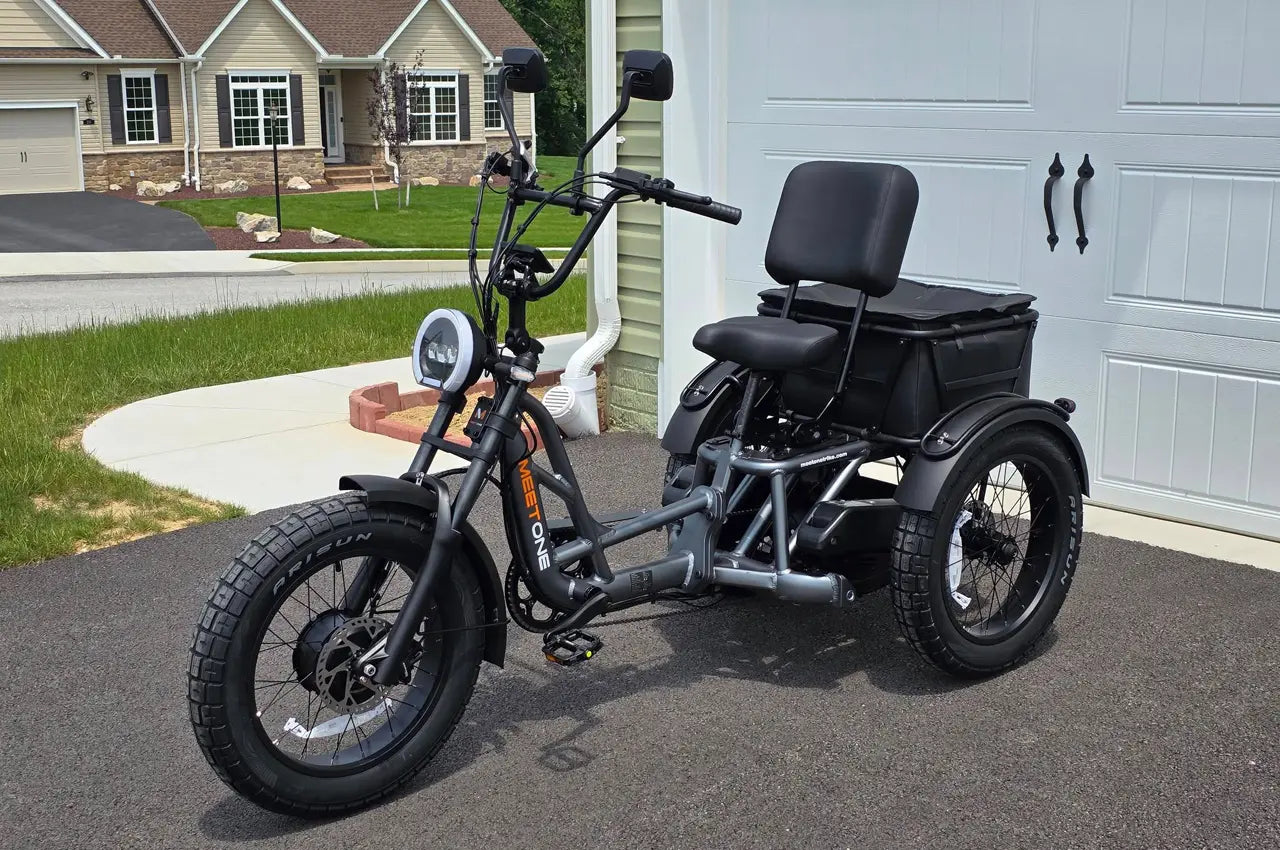
The Meet One Tour 2.0 is built to feel stable, supported, and capable under heavier rider weight, not just to list a high payload number on paper. Its dual-motor system, 50Ah battery, semi-recumbent design, full suspension, and 550 lbs payload rating address the situations heavier riders usually notice first.
The Meet One Tour 2.0 is not just built to carry more weight. It is built to perform properly under it. Instead of feeling like the trike is struggling to keep up, the Tour 2.0 feels steady, supported, and in control.
How Does the Tour 2.0 Help With Hill Starts?
The Meet One Tour 2.0 helps heavier riders with hill starts by using a dual-motor system that delivers smoother low-speed power under load. For heavier riders, strong hill-start performance matters because starting uphill is one of the first places underpowered trikes feel strained.
Underpowered systems can feel slow, strained, or inconsistent when more weight is involved. Sometimes they hesitate before delivering power. Sometimes they struggle to hold momentum on inclines.
The Tour 2.0’s dual-motor system changes that. Power delivery feels smooth and immediate, even at low speeds and under full rider weight. This is not just about top speed. It is about torque under load.
How Does the Tour 2.0 Support Longer Rides?
The Meet One Tour 2.0 supports longer rides with a 50Ah high-capacity battery designed to provide more consistent power under heavier rider demand. A larger battery helps reduce the feeling of performance fade during longer rides or higher-load conditions.
Heavier riders naturally demand more from the battery system. On many trikes, that shows up as fading performance: strong at the start, then noticeably weaker as the ride continues.
The Tour 2.0’s 50Ah battery helps power stay steady from start to finish. That matters even more on longer rides, hilly routes, throttle use, cargo trips, and stop-and-go riding.
How Does the Tour 2.0 Improve Body Comfort?
The Meet One Tour 2.0 improves comfort for heavier riders with a semi-recumbent riding position that supports more body weight across the seat and back instead of concentrating pressure on the knees, wrists, hips, and lower back.
On traditional upright trikes, body weight stacks onto the knees, wrists, and hips. Over time, that pressure adds up, and heavier riders often feel it faster.
The Tour 2.0’s semi-recumbent design changes how that weight is distributed. Your weight is supported across your back and seat, not concentrated on your joints. That can create a more relaxed riding position that feels easier to stay in for longer rides.
How Does Full Suspension Help Heavier Riders?
The Tour 2.0’s full suspension system helps heavier riders by absorbing road impact before it transfers through the frame, seat, hips, and lower back. More rider weight can make every bump feel stronger, so suspension can have a bigger comfort impact for heavier riders.
Road impact does not hit every rider the same way. The more weight you carry, the more noticeable every bump can become. On a rigid or lightly suspended trike, that shock transfers straight into your body.
Instead of feeling every crack in the road, the Tour 2.0’s full suspension helps the ride stay smoother, more controlled, and less fatiguing over time.
How Does the Tour 2.0 Feel More Stable?
The Meet One Tour 2.0 feels more stable for heavier riders because its semi-recumbent design helps lower the rider’s center of gravity and create a more planted riding feel. A stable trike reduces the need for constant body adjustments while turning or riding at moderate speeds.
Balance and stability matter more when there is more weight involved. Some trikes feel narrow or top-heavy, especially when turning or riding at moderate speeds.
The Tour 2.0’s wider stance and lower center of gravity help reduce that cautious, top-heavy feeling. You do not have to ride nervously just to feel stable. The trike already feels planted under you.
Why Does Throttle Support Matter for Heavier Riders?
Throttle support matters because heavier riders may not want to pedal through every hill, long route, sore-knee day, or low-energy ride. A throttle option gives the rider more flexibility when pedaling is uncomfortable or not ideal.
Not every ride is a strong day. Sore knees, low energy, unexpected hills, or a route that feels longer than expected can change how much effort you want to put in.
The Tour 2.0 gives riders the option to rely on throttle when pedaling is not ideal. You do not have to choose between pushing through discomfort and not riding at all.
How Should Heavier Riders Compare Electric Trikes?
Heavier riders should compare electric trikes by real-world capability, not just advertised specifications. The best choice is the trike that still feels stable, smooth, powerful, and controlled when carrying the rider’s actual weight, cargo, and riding conditions.
| Question to Ask | Why It Matters | Good Sign |
|---|---|---|
| Does the trike have payload headroom? | A trike should not feel like it is operating at its maximum limit with the rider alone. | The listed payload leaves room for rider weight, cargo, and accessories. |
| Does it start smoothly from a stop? | Heavier riders need confident low-speed power, especially at intersections and hills. | The motor feels smooth, immediate, and controlled under load. |
| Does it climb without fading? | Hill climbing exposes weak motors and limited battery systems quickly. | The trike holds momentum without feeling strained. |
| Does it feel comfortable after 20–30 minutes? | Seat pressure, joint strain, and road shock become more obvious on longer rides. | The seat, riding position, and suspension reduce fatigue. |
| Does it brake predictably? | Higher total weight demands steady, controlled braking. | The trike slows confidently without sudden grabbing or panic braking. |
What Is the Difference You Actually Feel?
The biggest difference for heavier riders is whether the electric trike feels like it is struggling or like it still has more to give. A capable electric trike should feel steady under your weight, not pushed to its limit every time you ride.
On an underbuilt trike, heavier riders often feel like they are asking too much from the machine. Starts feel slow. Hills feel strained. Turns feel cautious. Bumps feel harsh. Braking feels tense.
On the Meet One Tour 2.0, that feeling changes. It does not feel like the trike is struggling with your weight. It feels like it still has more to give. That difference is the gap between a trike that barely handles the job and one that makes you feel supported every time you ride.
Final Thoughts: What Is the Perfect Electric Trike for a Heavier Rider?
The perfect electric trike for a heavier rider is one that does more than hold your weight. It should feel powerful when starting, stable when turning, comfortable on longer rides, smooth over rough surfaces, and controlled when braking.
A good trike does not just carry your weight. It removes the problems that usually come with it. You should not have to wonder whether the motor is strong enough, whether the battery will fade, whether the frame feels stable, or whether your body will start paying for the ride halfway through.
The Meet One Tour 2.0 is built so heavier riders can focus less on whether the trike can handle the ride and more on enjoying the ride itself. You just ride, and it feels steady, comfortable, and capable the entire time.
FAQ: Electric Trikes for Heavier Riders
What is the best electric trike for a heavier rider?
The best electric trike for a heavier rider is one with enough payload capacity, strong motor torque, reliable braking, a stable frame, supportive seating, and suspension comfort. A higher payload rating helps, but real-world stability and power under load are just as important.
Is payload capacity the same as rider weight limit?
Payload capacity is not always the same as rider weight limit. Payload usually includes the rider, cargo, accessories, and anything carried on the trike. Heavier riders should leave extra payload headroom for baskets, bags, groceries, locks, water, and daily cargo.
Do heavier riders need dual motors on an electric trike?
Heavier riders do not always need dual motors, but dual motors can help with smoother starts, stronger hill climbing, and better power delivery under load. Dual motors are especially useful for heavier riders who ride hills, carry cargo, or want more confident acceleration.
Does rider weight affect electric trike range?
Yes, rider weight can affect electric trike range because more total weight requires more energy during acceleration, climbing, and stop-and-go riding. Terrain, tire pressure, speed, assist level, cargo weight, wind, and battery size also affect real-world range.
Why is a semi-recumbent electric trike good for heavier riders?
A semi-recumbent electric trike can be good for heavier riders because it distributes more body weight across the seat and back instead of concentrating pressure on the knees, wrists, hips, and lower back. This riding position can feel more stable and comfortable on longer rides.
Share:
How to Transport a Trike When Traveling: Practical Tips That Actually Work
What Features Etrikes Have That Regular Tricycles Don't