

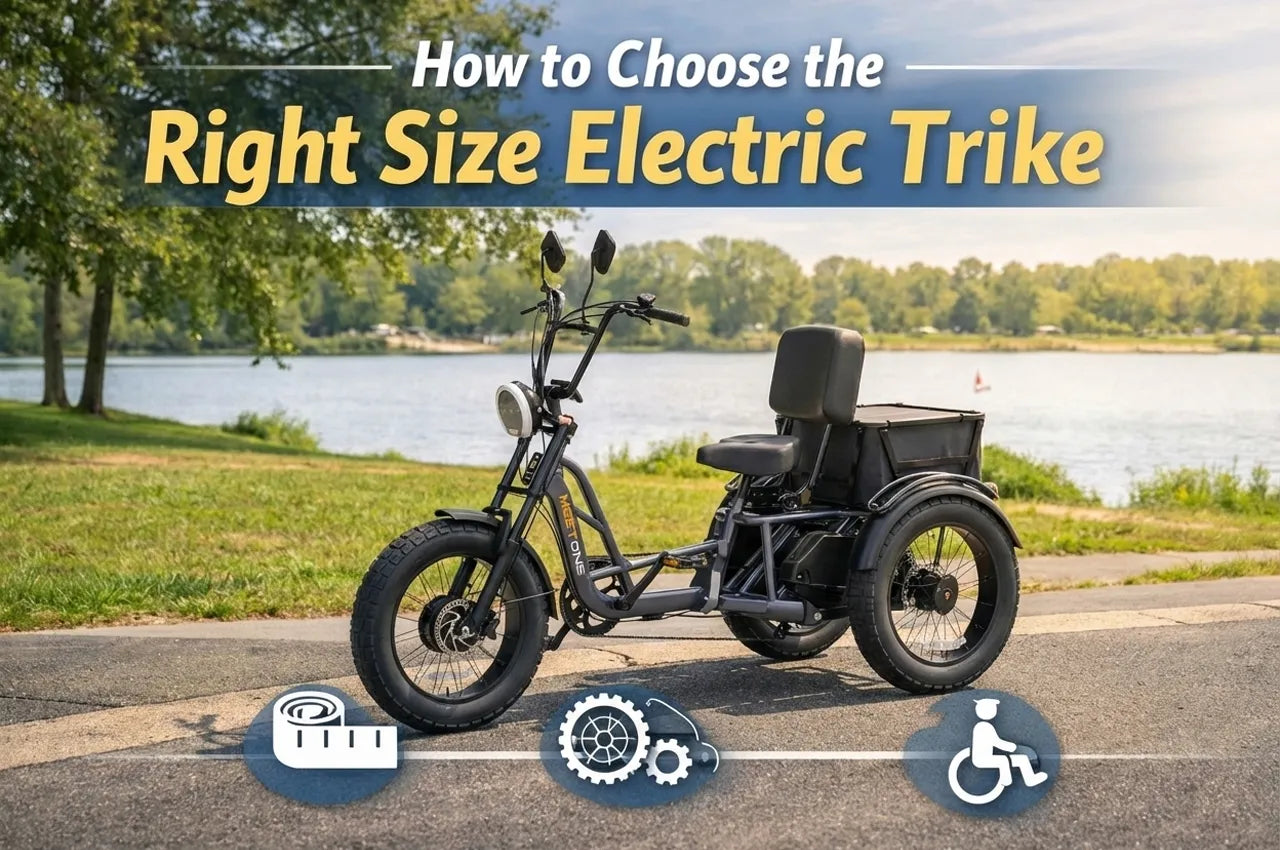
Choosing the right size electric trike is not based on height alone. In real-world fitting, the correct size depends on trike configuration, physical ability, stability needs, wheel size, and overall riding comfort. Unlike bicycles, trikes fit riders through geometry and seating position rather than traditional frame sizing, which is why two riders of the same height can require very different trikes.
Trike Configuration Determines Fit More Than Frame Size
Tricycles are built in different configurations, and configuration affects fit more than frame size alone. Traditional upright trikes place the pedals directly under the rider and position the seat higher off the ground. Semi-recumbent and recumbent trikes lower the seat and move the pedals forward, allowing the rider to pedal in front of the body.
Based on extensive test riding with adult and senior riders, three configurations are most common:
- Traditional upright trikes where riders pedal straight below their body
- Semi-recumbent trikes with a relaxed seating position and forward pedals
- Full recumbent trikes with a low seat and fully forward pedaling
Because leg extension comes from pedal reach rather than seat height, semi-recumbent and recumbent trikes can fit a wider range of riders. Even trikes with larger tires or longer frames may still be appropriate if the seat remains low and pedal reach is adjustable.
Physical Ability Should Be Considered Before Height
Physical ability is often the most important sizing consideration. Riders with balance issues, knee pain, hip stiffness, or arthritis may struggle to mount and dismount a traditional upright trike, even if the frame size appears correct.
However, it is also important to distinguish between semi-recumbent and full recumbent designs. While both lower the rider compared to upright trikes, they do not present the same accessibility.
Semi-recumbent trikes typically allow:
- A lower but still accessible seat height
- Easier mounting and dismounting than upright trikes
- Proper leg extension without forcing the seat too high
Recumbent trikes sit much closer to the ground. While this improves stability, it can make standing up more difficult for riders with arthritis or limited joint mobility. For some seniors, a seat that is too low can be just as problematic as one that is too high.
Stability Varies Clearly by Configuration
While all trikes are more stable than two-wheeled bikes, stability varies significantly by design. Trikes with longer frames and lower seating positions have a lower center of gravity, which improves stability and reduces tipping risk.
Recumbent trikes are the most stable. Their very low seating position and long wheelbase create the lowest center of gravity and the least tipping risk, especially during turns or low-speed riding.
Semi-recumbent trikes offer a high level of stability while remaining easier to access. Their slightly higher seat raises the center of gravity compared to full recumbents, but they are still significantly more stable than traditional upright trikes.
Traditional upright trikes position the rider the highest. While they can be stable when ridden carefully, they carry a higher tipping risk during sharp turns or on uneven terrain.
Wider tires, such as four-inch fat tires, improve stability but do not fully offset a high seating position.
Riders who prioritize maximum stability should focus on seat height and frame geometry first, then tire width second.
Height, Leg Length, and Wheel Size in Real-World Fit
Height and leg length still matter, but they must be evaluated in context. Shorter riders often encounter problems when the trike frame sits too high off the ground. In practice, even a one- or two-inch increase in seat height can make pedaling uncomfortable or inefficient.
In practical fitting experience:
- Riders around 4'10" to 5'0" often require very low seat heights
- Trikes with 16-inch wheels frequently work better for shorter riders
- Moving to 20-inch wheels can raise the frame enough to create pedaling or mounting issues
Semi-recumbent trikes often accommodate both shorter and taller riders more easily because seat height and pedal reach can be adjusted independently.

Meet One Tour / Dual Motor Semi-recumbent Electric Trike
Seating Position Directly Affects Comfort and Usability
Sizing is not only about reaching the pedals. Seating position plays a major role in long-term comfort. Some riders are most comfortable pedaling directly beneath their body, while others prefer pedaling forward, which reduces pressure on the knees and hips.
Key factors include:
- seat height
- seat angle
- back support
- handlebar reach
- and pedal placement
Riders who feel pressure in their knees, hips, or lower back are often experiencing a mismatch between seating position and configuration, not simply an incorrect size.
Proper sizing results in a trike that feels stable, easy to mount, and comfortable over longer rides. A correctly sized trike should not require the rider to strain when getting on or off, nor should it place excessive stress on joints while pedaling.
A trike that feels uncomfortable after a short ride will rarely be used, regardless of how well it fits on paper.
Quick Trike Selection Guide (At a Glance)
Choosing the right trike comes down to matching the design to your body, preferences, and riding habits. All three trike styles—upright, semi-recumbent, and full recumbent—can be the right choice when used by the right rider.
Riders who want a traditional bike-like feel and easy visibility
→ Traditional upright trike
→ Ideal for riders who are comfortable mounting a higher seat and prefer pedaling directly beneath their body
Riders who value familiarity and simple control at low speeds
→ Traditional upright trike
→ Often preferred for neighborhood rides, bike paths, and casual cruising
Short riders (around 4'10"–5'2") with no major joint issues
→ Semi-recumbent trike with a low seat height and smaller wheels
→ Easier pedal reach without sacrificing stability
Riders with knee pain, hip stiffness, or arthritis
→ Semi-recumbent trike
→ Lower and more stable than upright, but not as difficult to stand up from as a full recumbent
Riders who want more stability but still easy entry and exit
→ Semi-recumbent trike
→ Best balance between comfort, stability, and accessibility
Riders with serious balance concerns and good joint mobility
→ Recumbent trike
→ Maximum stability due to the lowest center of gravity
Taller riders (over 5'10") who want adjustability
→ Semi-recumbent or upright trike with sufficient pedal reach
→ Choice depends more on riding preference than height alone
Conclusion
Choosing the right size tricycle or electric trike requires more than matching height to a frame. The correct fit is determined by a combination of factors, including:
- configuration
- physical ability
- stability requirements
- wheel size
- seating position
Together, these elements determine whether a trike truly fits the rider.
Traditional upright electric trikes remain a good option for riders who prefer a familiar bike-like riding position, are comfortable with a higher seat height, and value visibility and simplicity. When properly sized and ridden within their comfort range, upright trikes can be stable, practical, and enjoyable for everyday use.
Recumbent trikes offer the highest stability but may be too low for riders with joint issues.
Semi-recumbent electric trikes often provide the best balance of stability, comfort, and accessibility for a wide range of riders, especially seniors.
Ultimately, proper sizing shows itself in real use. When a trike feels easy to get on, stable to ride, and comfortable over time, it is correctly sized.

Share:
Can You Buy an Electric Tricycle Online from a Trusted Store?
Electric Trike for Two Adults – Meet One Pair Electric Trike with Passenger Seat