

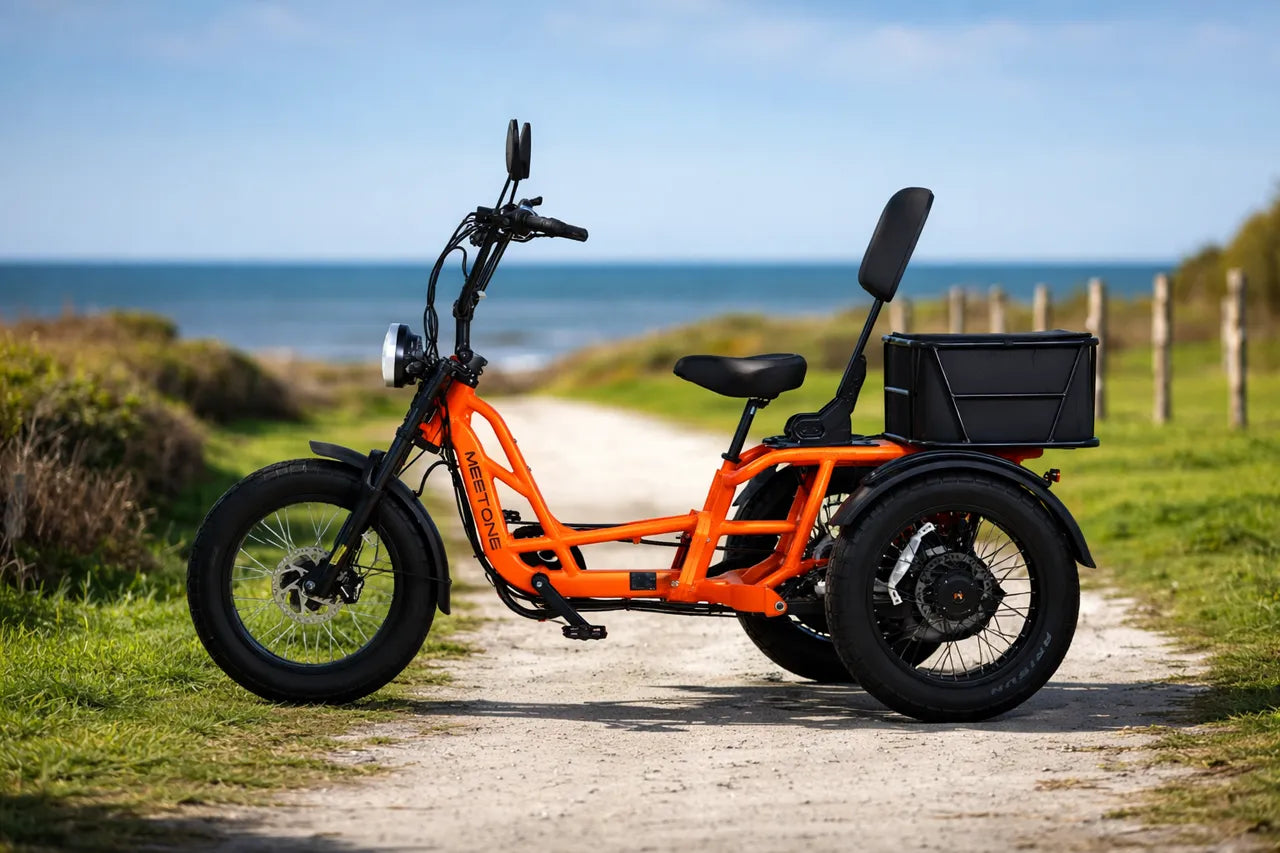
The Tour 2.0 is our most capable electric trike to date. Built on the foundation of the original Tour, the Tour 2.0 brings a larger battery, a reinforced rear frame with double the cargo capacity, and a convertible dual rear seat — making it the right choice for riders who need a trike that works as hard as they do.
This page covers everything you need to know before buying: how the Tour 2.0 rides, what it can carry, who it's built for, and how it compares to everyday riding needs.
Meet One Tour 2.0 Key Specifications
| Feature | Specification |
|---|---|
| Motor | Dual 750W hub motors |
| Battery | 50Ah lithium battery |
| Range | Up to 200 miles |
| Top Speed | 16 mph (25 mph unlocked) |
| Total Payload | Up to 550 lbs |
| Rear Cargo Capacity | Up to 200 lbs |
| Suspension | Full suspension |
| Brakes | 180mm hydraulic disc |
| Passenger Seating | Convertible dual rear seat |
| Trailer Compatible | Yes |
Ride Quality and Comfort
The Tour 2.0 is built around a semi-recumbent seating position with a full backrest, which keeps you in a relaxed, upright posture rather than hunched forward. On longer rides, this makes a noticeable difference — you can ride for extended periods without the back and wrist fatigue that comes with a traditional upright bike position.
The full suspension system — a double shoulder fork up front and dual rear shocks — absorbs road vibrations and bumps effectively. Whether you're on smooth pavement, cracked sidewalks, or rougher paths, the ride stays controlled and comfortable rather than harsh.
The three-wheel configuration means the Tour 2.0 stays planted at stops, on hills, and when carrying cargo. There's no balancing required, which makes it accessible for riders returning to cycling after a long break, older riders, or anyone who wants a more confident riding experience.
Motor and Power Delivery
The Tour 2.0 runs dual 750W hub motors — one at the front wheel, one at the rear — delivering strong, consistent torque across all terrain types. On flat roads, acceleration is smooth and effortless. On inclines, the dual-motor setup maintains power without struggling, even when carrying cargo or a passenger.
Power delivery is controlled by a torque sensor rather than a basic cadence sensor. This means the motor responds to how hard you're actually pedaling, not just whether you're pedaling. The result is a natural, intuitive ride where assist feels proportional to your effort — you stay in control of your pace at all times.
Pedal assist operates across three levels. Level 1 runs a single motor for efficient, everyday riding. Level 2 activates both motors for more demanding terrain. Level 3 engages full dual-motor power for maximum performance. Top speed with pedal assist reaches 23.6 mph. The throttle has a default cap of 16 mph, which can be unlocked.
Battery and Real-World Range
The Tour 2.0 upgrades to a 50Ah lithium battery — a significant step up from the 30Ah dual-battery setup in the original Tour. More battery capacity means longer rides between charges and more consistent power output when the trike is under load.
Under ideal conditions — flat terrain, moderate assist, lighter loads — the Tour 2.0 can reach up to 200 miles on a single charge. The battery is removable, so you can charge it on or off the trike, wherever is most convenient.

Braking Performance
The Tour 2.0 is equipped with 180mm hydraulic disc brakes on all three wheels, providing reliable and responsive stopping power in all conditions. Hydraulic brakes require less hand pressure than mechanical disc brakes and maintain consistent performance whether the rotors are warm or cold, wet or dry.
A built-in parking brake lets you lock the trike in place on flat ground or inclines — useful when loading cargo, taking a break, or parking on a slope. Engaging it is a simple lever action; releasing it is equally straightforward.
Cargo Capacity: What You Can Actually Carry
The Tour 2.0's extended rear frame supports up to 200 lbs of cargo — double the 100 lb rear capacity of the original Tour. The total payload rating of 550 lbs covers the combined weight of the rider, any passenger, and cargo loaded onto the trike.
The rear platform is large enough for grocery runs, equipment hauls, and everyday errands. For loads that exceed the rear frame's capacity, the Tour 2.0 includes a trailer hitch point, allowing you to attach a compatible trailer and expand your hauling range further.
Passenger Seating
The Tour 2.0 introduces a convertible dual rear seat — a feature not available on the original Tour. The seat installs onto the extended rear frame without permanent modification, and can be removed just as easily when you need the full cargo platform instead.
This makes the Tour 2.0 practical for couples, families, and any rider who occasionally needs to bring a second person along. The 550-lb total payload limit applies to the combined weight of both riders, so most adult combinations are well within range.
Handling and Maneuverability
The Tour 2.0's 7-speed gearing system gives you a wide range of resistance options, whether you're cruising at low speed or pushing through a longer stretch. Gear transitions are smooth, and having multiple gears prevents the ghost pedaling at higher speeds that single-speed trikes often experience.
Electric reverse mode lets you back the trike out of tight spots by holding the minus button — no physical effort required. This is especially useful in garages, on narrow paths, or anywhere you'd otherwise need to manually push a heavy trike backward.
The Tour 2.0's extended rear frame requires a wider turning radius than compact trikes. It's designed for paths, roads, and open spaces rather than dense urban environments with very tight corners.
Assembly and Setup
The Tour 2.0 arrives largely pre-assembled. Getting it road-ready involves attaching the front wheel and fenders, following a straightforward process with clearly illustrated instructions. Most riders complete setup without needing additional tools or mechanical experience.
Who the Tour 2.0 Is Built For
Riders who need serious cargo capacity. With 200 lbs of rear load capacity and trailer compatibility, the Tour 2.0 handles grocery runs, equipment hauls, and utility tasks that a standard e-bike or basic trike cannot.
Riders who want to bring a passenger. The convertible dual rear seat turns the Tour 2.0 into a two-person vehicle without requiring a separate purchase or permanent modification.
Heavier riders. The 550-lb total payload accommodates a wider range of body types than most consumer electric trikes on the market.
Riders prioritizing comfort on longer rides. The semi-recumbent seat, full suspension, and torque-sensor assist make extended rides significantly more comfortable than upright, unsuspended alternatives.
Riders who want stability over agility. The three-wheel design and wide stance trade tight-space maneuverability for a planted, confident ride under all load conditions.
Frequently Asked Questions
How far can the Tour 2.0 travel on a single charge?
Up to 130 miles under ideal conditions. Most riders can expect 55 to 75 miles in everyday use with a mix of pedal assist and throttle. Heavier loads and higher assist levels will reduce range.
Can the Tour 2.0 carry two adults?
Yes. The convertible dual rear seat supports a second passenger. Both riders' combined weight counts toward the 550-lb total payload limit.
What is the difference between total payload and rear cargo capacity?
Total payload (550 lbs) is the maximum combined weight of the rider, passenger, and all cargo. Rear cargo capacity (200 lbs) is the maximum load the rear platform itself can support. Both limits apply at the same time.
Can I tow a trailer with the Tour 2.0?
Yes. The Tour 2.0 includes a trailer hitch point compatible with supported Meet One trailers.
How does the Tour 2.0 differ from the original Tour?
The Tour 2.0 upgrades the battery from 30Ah to 50Ah, increases rear cargo capacity from 100 lbs to 200 lbs, adds a convertible dual rear seat, and introduces an extended rear frame with new color options.
Is the Tour 2.0 suitable for riders who haven't cycled in years?
Yes. The three-wheel design requires no balancing, and the torque sensor provides smooth, gradual assist that's easy to control. The semi-recumbent seat also reduces physical strain compared to traditional bike positions.
Specifications sourced from Meet One product documentation. Range figures may vary based on rider weight, terrain, temperature, and assist settings.

Share:
Best Electric Trikes for Seniors Over 70
Meet One Tour 2.0 vs Tour: What’s New in the Latest Electric Trike?
1 comment
Two questions:
1. Can I only slowly peddle the bike if I want to take my two large dogs on a walk while I ride? I am really counting on this bike being stable if they try to pull while on a walk.
2. If I could build a suitable trailer to contain my dogs , could this bike haul the trailer and the dogs (dogs combined weight is about 260 lbs). Have no idea about the trailer. Wondering how much weight this bike can pull.
Please comment in as detailed a way if you can. Love this bike, but I need ti take my dogs into consideration.
Thank you!