

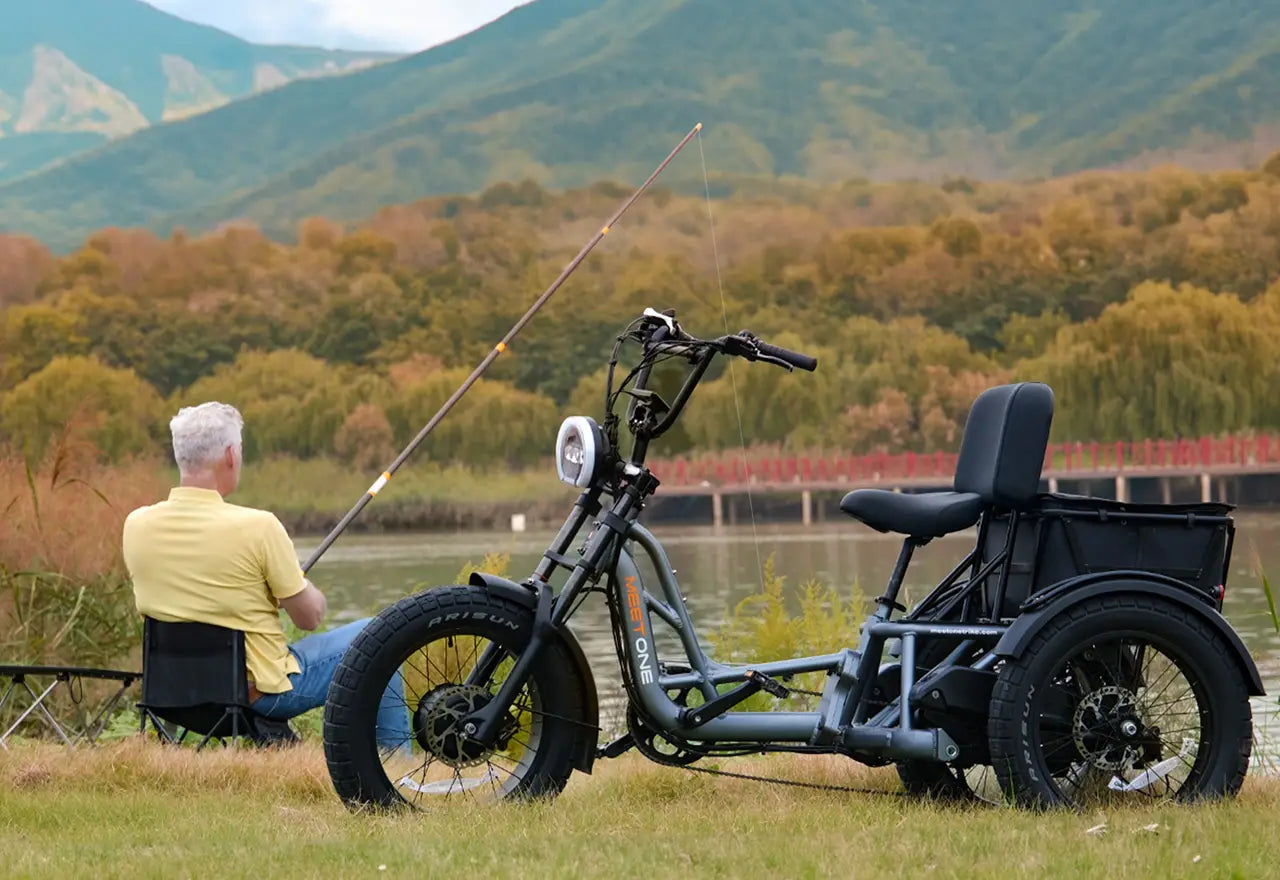
Editor’s note: This article originally reviewed the earlier Meet One Tour dual-motor electric trike. The original Tour has since been updated with the newer Tour 2.0. This page is kept as an older-model archive for riders comparing past Tour features, while current shoppers should review the latest Tour 2.0 before buying.
The original Meet One Tour eTrike was designed for riders who wanted more power, more range, and more comfort than a basic electric trike. With dual motors, dual batteries, full suspension, hydraulic braking, and a supportive high-back seat, it became a strong option for riders who needed a capable comfort-focused trike for longer rides and varied terrain.
Today, the Tour lineup has moved forward with the newer Meet One Tour 2.0. If you are shopping for a current Meet One electric trike, we recommend reviewing Tour 2.0 instead of relying only on the older Tour specifications below.
Original Tour eTrike Review: What Riders Liked
The original Tour eTrike was built for riders who wanted a more powerful and stable ride. Its dual-motor system gave it strong acceleration and traction support, while the dual-battery setup made it suitable for longer rides, daily commuting, and outdoor exploring.
Comfort was another major part of the original Tour design. The oversized seat, high backrest, full suspension system, and semi-reclined riding posture helped make longer rides feel smoother and more supported.
Original Tour vs Tour 2.0: What Changed?
The original Tour helped define Meet One’s high-power comfort trike category. The newer Tour 2.0 builds on that foundation with an updated long-range platform, current model availability, and a more modern riding experience for adults and seniors.
| Feature | Original Tour | Tour 2.0 |
|---|---|---|
| Status | Older Tour model archive | Current upgraded Tour model |
| Riding position | Semi-reclined comfort posture with oversized seat and backrest | Comfort-focused semi-recumbent riding design with updated ride feel |
| Best for | Longer rides, city commuting, trail-style riding, and riders wanting extra power | Long-range riding, senior comfort, outdoor exploring, cargo needs, and riders comparing current Tour features |
| Power concept | Dual-motor power with front and rear hub motors | Updated Tour 2.0 dual-motor platform |
| Battery concept | Dual-battery long-range setup | Updated long-range battery system depending on current configuration |
| Comfort focus | Full suspension, oversized seat, high backrest, and stable trike platform | Updated comfort-focused suspension and semi-recumbent ride design |
| Current availability | No longer the current Tour model | View Tour 2.0 |
Note: This page discusses the earlier Tour model for archive and comparison purposes. For current pricing, availability, range, battery capacity, and specifications, please refer to the latest Tour 2.0 product page.
Key Features of the Original Tour eTrike
The original Tour eTrike offered a high-power, comfort-focused riding experience. While it is no longer the current Tour model, many of its core ideas continue in Tour 2.0.

Dual 750W motors: The original Tour used front and rear hub motors to provide strong, balanced power for city streets, uneven surfaces, and more demanding routes.
Dual-battery long-range setup: The original Tour was designed for riders who wanted extended range for daily commutes, recreational rides, and longer trips.
Torque-sensor pedal assist: The original Tour used torque-sensor assistance to create a smoother, more natural ride feel based on how hard the rider pedaled.
Full suspension system: Front suspension and rear shock absorption helped reduce bumps and vibration, making the ride more comfortable on rough pavement and uneven paths.
Oversized seat with backrest: A wide seat and high backrest supported a more relaxed semi-reclined riding posture.
Hydraulic disc brakes: The original Tour included hydraulic braking for stronger, more controlled stopping performance.
Electric reverse mode: Reverse assist made it easier to maneuver the trike in garages, parking areas, driveways, and tight spaces.
Practical storage: Front and rear baskets helped riders carry groceries, gear, personal items, and everyday essentials.
Power and Long-Range Riding
The original Tour was known for its dual-motor and dual-battery setup. This made it a strong choice for riders who wanted a more capable electric trike for hills, longer trips, outdoor routes, or heavier everyday use.
The newer Tour 2.0 takes the Tour concept further with an updated long-range platform. If your priority is strong power, long-range riding, and a more capable electric trike setup, the current Tour 2.0 product page is the best place to check the latest specifications.
Comfort, Suspension, and Riding Position
One of the strongest parts of the original Tour was comfort. The full suspension system helped absorb road vibration, while the oversized seat and backrest allowed riders to sit in a more relaxed, supported position.
This type of setup can be especially helpful for riders who want a more stable and comfortable alternative to a traditional two-wheel e-bike. It also makes sense for riders who expect to spend more time in the saddle and want less upper-body strain during longer rides.
Tour 2.0 continues this comfort-focused direction with a more current platform for riders who want power, support, and long-range capability.
Safety, Braking, and Practical Control
The original Tour included practical control features such as hydraulic disc brakes, hydraulic parking brake support, lighting, turn signals, differential support, and electric reverse mode. These features helped riders manage a larger, more capable electric trike with more confidence.
As with all electric trikes, riders should slow down before turns, avoid sharp cornering, and practice in an open area before riding near traffic or pedestrians. Three wheels can improve low-speed balance, but safe trike handling still matters.
Should You Still Buy the Original Tour?
Most new shoppers should start with the current Tour 2.0 rather than the original Tour. The older Tour can still be useful as a reference point if you are comparing past Meet One models, researching a used trike, or trying to understand how the Tour lineup has evolved.
For a new purchase, Tour 2.0 is the better place to start.
Final Recommendation
The original Meet One Tour eTrike was a powerful, comfort-focused electric trike built for riders who wanted dual motors, extended range, full suspension, hydraulic braking, and a supportive semi-reclined riding position.
However, because the original Tour is no longer the current model, most current shoppers should review Tour 2.0 for current specifications, battery options, pricing, and availability.
FAQ
Is the original Meet One Tour still the current model?
No. The original Meet One Tour has been updated with the newer Tour 2.0. This page is kept as an older-model archive.
What replaced the original Meet One Tour?
The current replacement is Meet One Tour 2.0. Shoppers should check the Tour 2.0 product page for the latest specifications, pricing, and availability.
Why did riders like the original Tour eTrike?
Riders liked the original Tour because it offered dual-motor power, dual-battery range, full suspension, hydraulic brakes, reverse mode, practical storage, and a comfortable semi-reclined riding position.
Should I choose Tour 2.0 instead of the original Tour?
For a new purchase, yes. Since the original Tour is no longer the current model, most riders should start with Tour 2.0.
Can I still use this original Tour review?
Yes, but only as an older-model reference. It is useful for understanding the original Tour design, but current shoppers should check Tour 2.0 for updated specifications.

Share:
Breeze Folding Electric Trike: Perfect for Everyday Adventures
How Much Does an Electric Tricycle Weigh?