


Electric tricycles are no longer a niche product. As more adults seek stable, comfortable, and motorized alternatives to two-wheel cycling, the eTrike market has grown substantially, and so has the variety of designs available.
Understanding eTrikes means looking at two separate dimensions: how they are built, and what they are built for. The first dimension covers riding posture and wheel layout, which is the structural classification most buyers encounter first. The second covers functional purpose, the practical category that often drives the final purchase decision. Both matter, and the best choice usually sits at the intersection of the two.
Part One: Structural Types (Wheel Layout and Riding Posture)
The five main structural categories are defined by two factors: wheel layout (delta vs. reverse) and riding posture (upright, semi-recumbent, or recumbent). Each combination creates a distinct riding experience with different implications for stability, comfort, and ease of access.
Electric Tricycle Types Comparison
Electric tricycles can be grouped by wheel layout and riding position. This table compares the five main types.
| Type | Layout | Riding Position | Best For | Strengths | Considerations |
|---|---|---|---|---|---|
|
Traditional Upright eTrike
Delta
|
One front wheel, two rear wheels | Upright | Riders who want a traditional tricycle feel. |
|
|
|
Semi-Recumbent eTrike
Delta
|
One front wheel, two rear wheels | Relaxed / semi-recumbent | Riders who want comfort without sitting too low. |
|
|
|
Recumbent Delta eTrike
Delta
|
One front wheel, two rear wheels | Reclined | Riders who want back support and a relaxed ride. |
|
|
|
Upright Reverse eTrike
Reverse
|
Two front wheels, one rear wheel | Upright | Riders who want a more bicycle-like riding feel. |
|
|
|
Recumbent Reverse eTrike
Reverse
|
Two front wheels, one rear wheel | Reclined | Riders who want the lowest and most planted ride feel. |
|
|
Traditional vs. Reverse: Understanding the Wheel Layout
Most traditional adult electric tricycles place one wheel at the front and two wheels at the rear. In technical terms, this is known as a delta configuration, but most everyday riders simply think of it as the standard electric tricycle layout.
A reverse configuration flips this arrangement: two wheels sit at the front and one at the rear. In recumbent trike terminology, this is often called a tadpole layout. This difference changes how the trike handles through corners and affects how stable it feels at speed, depending on the rider’s posture and center of gravity.
1. Traditional Upright eTrike

The most recognizable form. The rider sits in a conventional cycling position, often with a step-through frame for easy mounting and dismounting. It is a natural first choice for riders transitioning from traditional bicycles or adult trikes, offering good road visibility and a familiar feel. Corners should be taken at a measured pace due to the higher center of gravity.
Best for: familiar riding position, easy access, neighborhood use.
2. Semi-Recumbent eTrike

This uses the same one-front-wheel, two-rear-wheel layout as a traditional adult tricycle, but with the seat angled into a more relaxed, slightly reclined position. This reduces pressure on the wrists, shoulders, and lower back without requiring the rider to sit close to the ground. A practical middle ground between comfort and accessibility.
Best for: comfort-focused riders who still want easy entry and exit.
3. Recumbent Delta eTrike

A fully reclined riding position with one front wheel and two rear wheels. The lower center of gravity improves stability, and the reclined posture can make long rides considerably more comfortable. However, riders with limited knee, hip, or lower-body mobility should consider carefully. Mounting and dismounting from a reclined position requires more physical effort than upright designs.
Best for: riders prioritizing comfort and back support on longer rides.
4. Upright Reverse eTrike

Two wheels at the front and one at the rear, with the rider in an upright position. Many models in this category incorporate a tilting front mechanism that produces a steering feel closer to a two-wheeled bicycle, making it more active and allowing leaning through turns compared to a traditional delta trike. This appeals to riders who want the confidence of three wheels while keeping an engaged, dynamic riding sensation.
Best for: riders who want a bicycle-like experience with added stability.
5. Recumbent Reverse eTrike

Two front wheels and one rear wheel, with a low reclined riding position. This produces the lowest center of gravity of any eTrike category, and riders often describe the cornering feel as planted and confident. The tradeoff is accessibility. Sitting close to the ground makes getting in and out physically demanding, especially for riders with joint limitations.
Best for: riders who prioritize maximum stability and a planted road feel.
Part Two: Functional Types (Purpose and Use Case)
Beyond structural design, eTrikes are increasingly differentiated by what they are built to do. Functional categories cut across structural types. A folding trike can be upright or semi-recumbent, and a cargo trike can be delta or reverse. Understanding functional categories helps buyers match a trike to their actual daily use.
Folding eTrikes
Folding eTrikes are defined by one core advantage: space efficiency. The frame collapses, sometimes with the stem and handlebars folding down as well, significantly reducing the trike’s footprint when not in use. This makes it possible to store the trike in a smaller space, load it into a car or RV, or fit it in an apartment without dedicating an entire room to it.
It is worth being direct about weight: folding eTrikes are not lightweight vehicles. Even the lighter models start at around 60 lbs, and many exceed that. Folding does not make an eTrike easy to carry. It makes it possible to store and transport in spaces that a non-folding trike simply would not fit. That distinction matters when evaluating whether a folding model suits a specific situation.
Key features to look for:
- Folded dimensions, how much space the trike actually occupies when collapsed
- Folding mechanism simplicity, how quickly and reliably it folds and unfolds
- Frame rigidity when unfolded, a good folding mechanism should not compromise ride stability
- Battery removability, useful for charging indoors without moving the whole trike
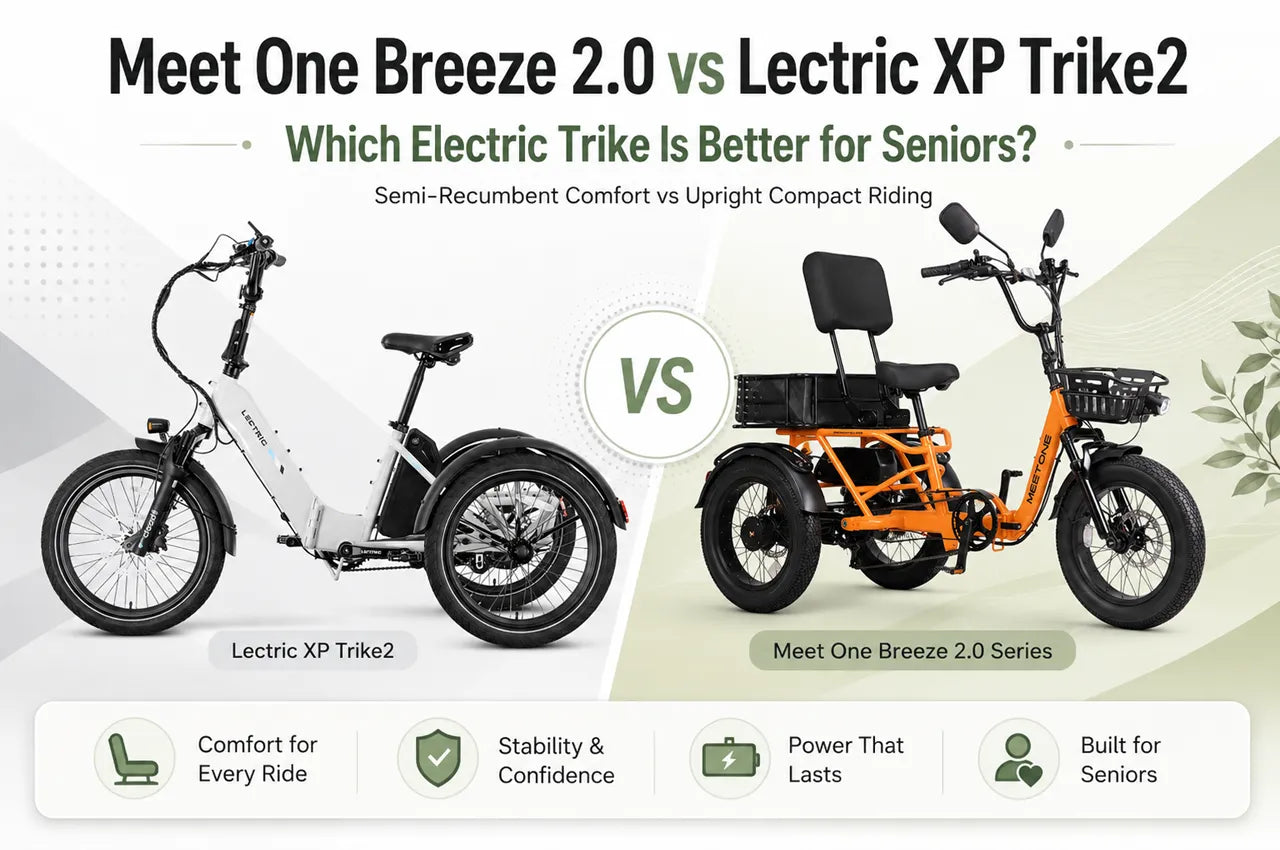
Folding eTrikes are well suited to riders with limited storage space, those who travel with their trike by vehicle, and anyone who needs to move the trike between locations regularly. The Lectric XP Trike and the Meet One Breeze Pro 2.0 are among the better-known models in this category.

Cargo eTrikes
Cargo eTrikes are built around carrying capacity. They typically feature extended rear decks, large rear baskets, reinforced frames, and motors powerful enough to maintain performance under load. Some models include front cargo compartments as well. Total payload capacities on cargo eTrikes often range from 450 lbs to 550 lbs, encompassing both the rider and the load.
Common cargo trike configurations:
- Rear basket, the most common setup, suitable for groceries, gear, and everyday errands
- Longtail design, an extended rear platform that can carry larger or irregularly shaped loads
- Front cargo box, found on some reverse-configuration models, placing the load ahead of the rider for direct visibility
- Dual basket, front and rear, maximizing total storage capacity
Cargo eTrikes serve a wide range of users, from riders running weekly errands to small business owners making local deliveries.
Passenger eTrikes
Passenger eTrikes, sometimes called rickshaw-style eTrikes, are designed to carry one or more additional riders alongside the driver. The passenger seat is typically positioned at the rear, often with seatbelts, a backrest, and sometimes a protective roof or canopy. This category represents a meaningful step up in both motor power and battery capacity, as the added weight of passengers requires more energy to move efficiently.
Things to consider when evaluating passenger eTrikes:
- Passenger seat safety features, including seatbelts, handholds, and secure footrests
- Motor wattage, since carrying passengers on hills demands more torque than a standard single-rider model
- Battery size, larger batteries help offset the range impact of added weight
- Age suitability, some models are designed with young children in mind while others are built for adult passengers
- Legal considerations, regulations around carrying passengers on eTrikes vary by region
Passenger eTrikes are popular with families, caregivers, and riders who regularly ride with companions.
Fat Tire and All-Terrain eTrikes
Fat tire eTrikes are equipped with wide tires, typically 3 to 4 inches across, that provide enhanced traction and shock absorption across a range of surfaces. Where standard eTrikes are optimized for pavement, fat tire models are built to handle sand, gravel, snow, light trails, and uneven ground without sacrificing stability.
What fat tires add to the riding experience:
- Increased traction on loose or slippery surfaces
- Improved shock absorption on rough terrain, reducing strain on the rider
- A more stable footprint due to the wider contact patch with the ground
- Versatility across seasons and surface types
Most fat tire eTrikes also pair the wider tires with front suspension forks and, on higher-end models, full suspension systems. This combination makes them a practical choice for riders who want a single trike that works for both everyday errands and occasional off-road or trail riding. Tire pressure is adjustable, allowing riders to fine-tune traction versus rolling resistance for different conditions.

How to Choose: Combining Structural and Functional Categories
Most buyers benefit from thinking in both dimensions at once. Structural type determines how the trike rides and how easy it is to get on and off. Functional type determines what the trike can do beyond moving the rider from point A to point B.
A few practical examples of how these dimensions combine:
- A rider with back, wrist, or shoulder discomfort may start with a semi-recumbent or recumbent structure for better body support, then choose cargo, folding, or all-terrain features based on daily use.
- A rider living in an apartment or traveling by RV may need a folding eTrike first, then decide whether an upright or semi-recumbent layout is easier to mount, ride, and store.
- A parent or caregiver carrying children should look at passenger-ready models, then compare frame layout, seating height, stability, and entry access for both rider and passengers.
- A rider who runs errands on pavement but also rides on gravel, grass, or rougher roads may need fat tires or all-terrain capability, then choose the riding posture that feels safest and most controlled.
- A rider mainly using the trike for groceries and neighborhood trips may prioritize cargo space, then choose an upright delta, semi-recumbent delta, or compact cargo model depending on comfort and ease of access.
Electric assist changes the calculus further: motor support reduces the physical demand of pedaling, which means comfort and ergonomics often matter more than raw pedaling efficiency. Riders who might have dismissed a heavier cargo or passenger trike on a traditional bicycle will often find that the motor makes those models entirely practical.
Final Thoughts
Electric tricycles offer something for a wide range of riders — from those returning to cycling after a long break, to active riders looking for greater comfort on longer routes, to practical users who need a reliable, motorized way to move cargo or travel with a companion.
The right eTrike sits at the intersection of structural fit and functional purpose. Understanding both dimensions is what allows a buyer to move from “I want an eTrike” to “I know exactly which eTrike is right for me.”

Share:
How to Choose the Right Electric Tricycle
How To install turn signal kit for Meet One Breeze Pro 2.0 eTrike?
1 comment
As an 80 year old man 1640 miles on my Breeze 1 pro, I’m wondering why you don’t have the front basket where my 10 year old Maltese dog prefers to ride; on the new Tour 2.0? That basket is so handy and with the premium seat he feels a little crowded out in the rear basket. Gizmo beats me to the trike each morning with his helmet and googles.